
.jpg "Still for essential-oil")
.jpg "E2-3 Supreme Construction")
.jpg "Construction")

.jpg "Preview: Still for essential-oil")
.jpg "Preview: E2-3 Supreme Construction")
.jpg "Preview: Construction")

.jpg "Still for essential-oil")
.jpg "E2-3 Supreme Construction")
.jpg "Construction")

Building optimised distillers since 2006
NEW! No more silicone seals required
DESTILLIERMEISTER FLEXI2-3 Supreme - The all-rounder
Legal and registration-free 2 litre hobby distiller made of stainless steel in heavy quality for various applications
The DESTILLIERMEISTER FLEXI2-3 Supreme impresses with its particularly solid material quality.
Private users in Germany are legally allowed to purchase this still without declaring it. This device may also be legally used here for obtaining essential oils and hydrosols.
In Austria, alcohol may also be legally produced with this still. The DESTILLIERMEISTER FLEXI2-3 Supreme is equally well suited for both applications.
When distilling schnapps, there are a number of possible applications. For example, aromatic fruit brandies can be produced or, by increasing the column resistance, it can also be used very well for purifying alcohol. The still can be used as a pot still and for reflux distillation because the distillation bridge can be attached to both the still and the column.
Essential oils and hydrosols
With 3 litres of plant space, the FLEXI2-3 Supreme has a decent volume for hobby distillers to process even larger quantities of plants or drugs. The steam is generated in a separate boiler under the plant container, so there is no possibility of coming into contact with boiling water. And the best thing is: since the water boiler has a volume of only 2 litres despite the large plant container, the DESTILLIERMEISTER FLEXI2-3 Supreme is also legal in Germany and Austria and can therefore be sold and operated without being reported to customs.
As an added bonus, you will receive a sachet of dried lavender flowers in an aroma-protection packaging so that you can try out your essential oil still straight away.
Easy to use:
- In the new model, no seals are required between 1 and 2 or 3 and 4 due to optimised clamping locks. Sealing works metallically. Therefore, there are no follow-up costs for this model.
- Fill 1.5 litres into the water/steam boiler,
- attach the lid 2 and close with the clamping locks (1.1).
- Attach the 3 litre plant tube (3).
- Insert aroma basket (8) and fill with up to 3 litres of herbs or drugs – only lightly compress,
- attach lid (4) and tighten clamp fasteners (3.2).
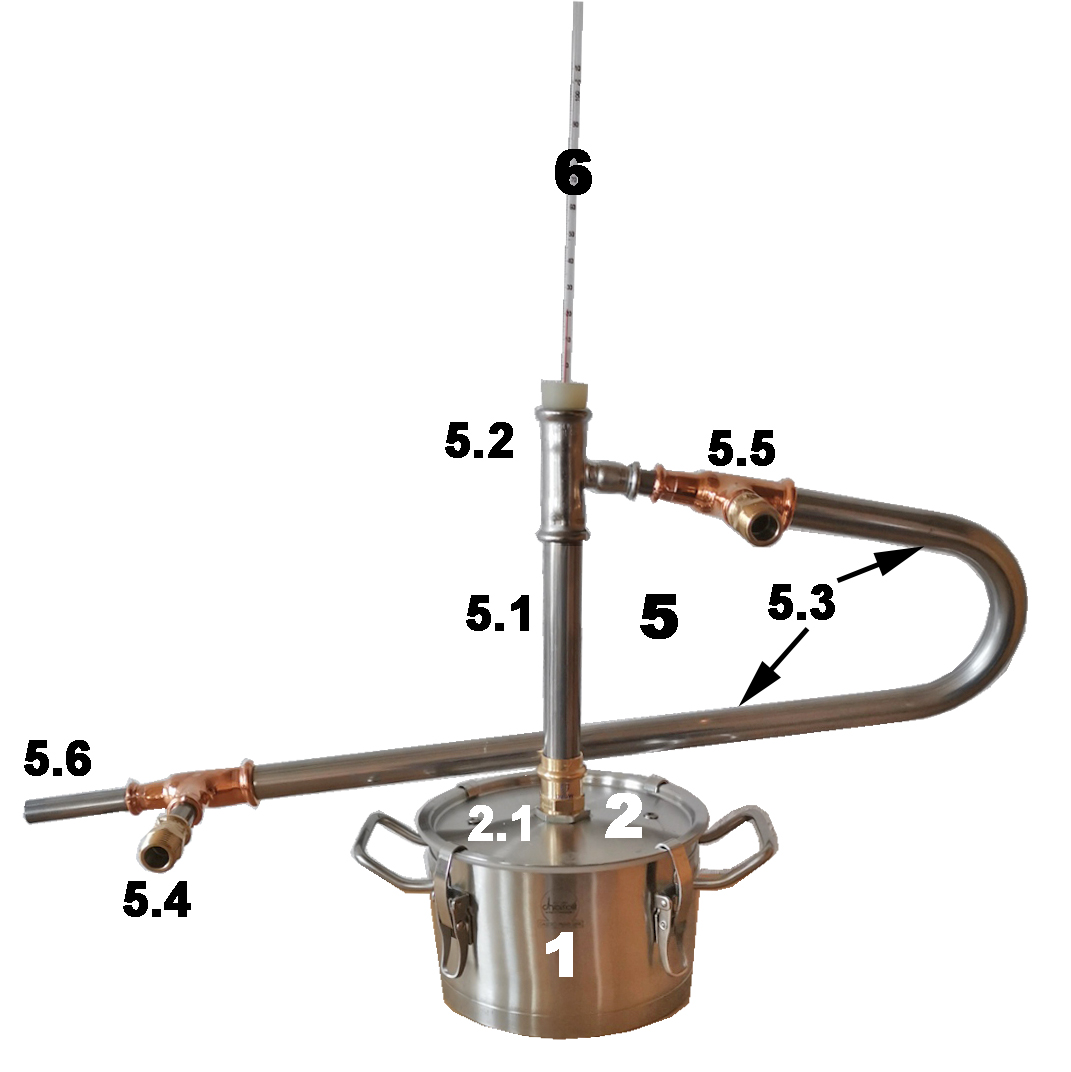
- Insert distillation bridge 5 into socket 4.1.
- Screw suitable cooling water hoses with 1/2’ threaded hose connections to the condenser, water supply via 5.4, waste water via 5.5.
- Switch on the heat source and collect the hydrosol with oil at 5.6.
- When the tube is full, distil for a maximum of 15 to 20 minutes at higher power (e.g. 1500 to 2000 watts on an induction plate). For smaller quantities, the heating power must be reduced.
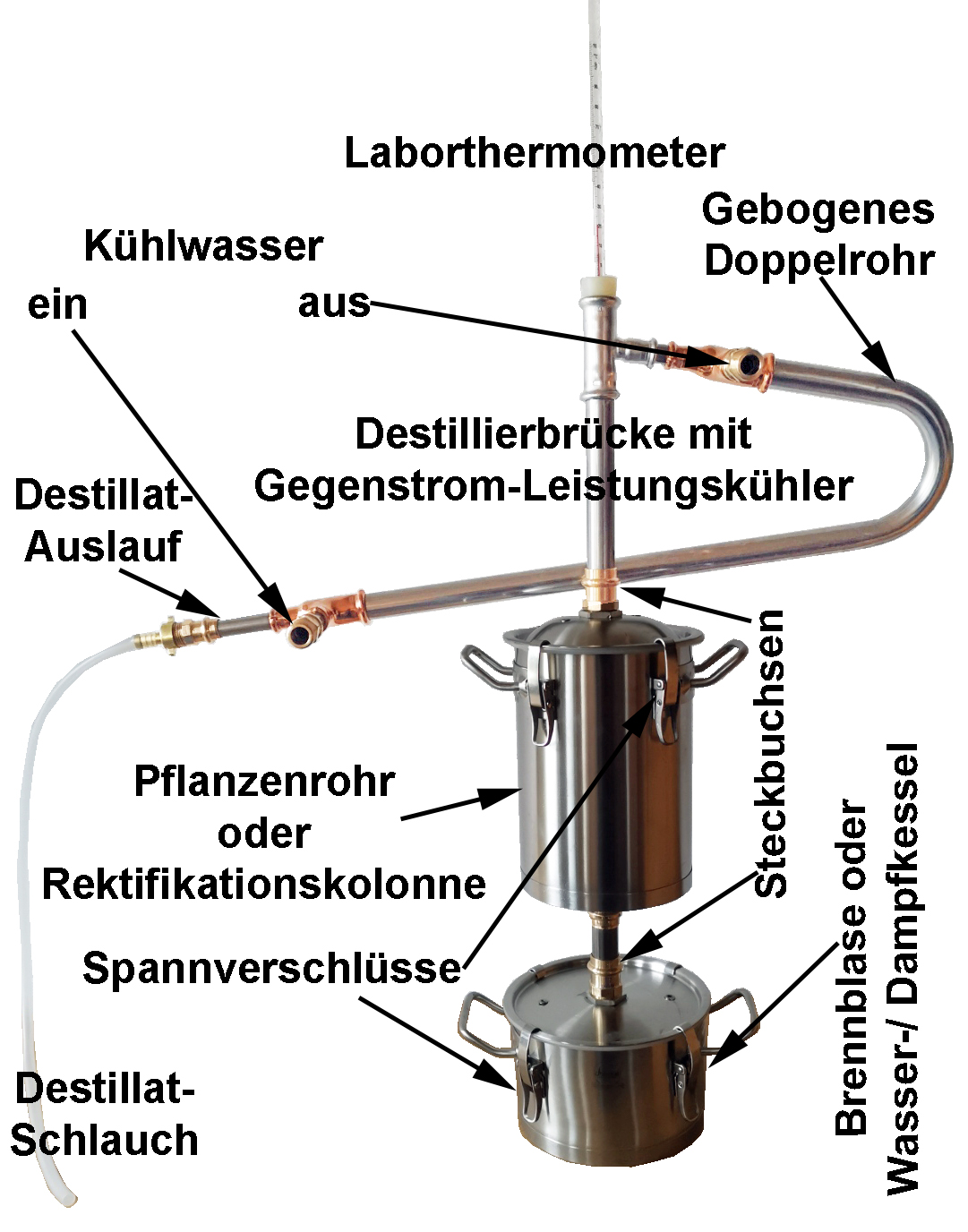
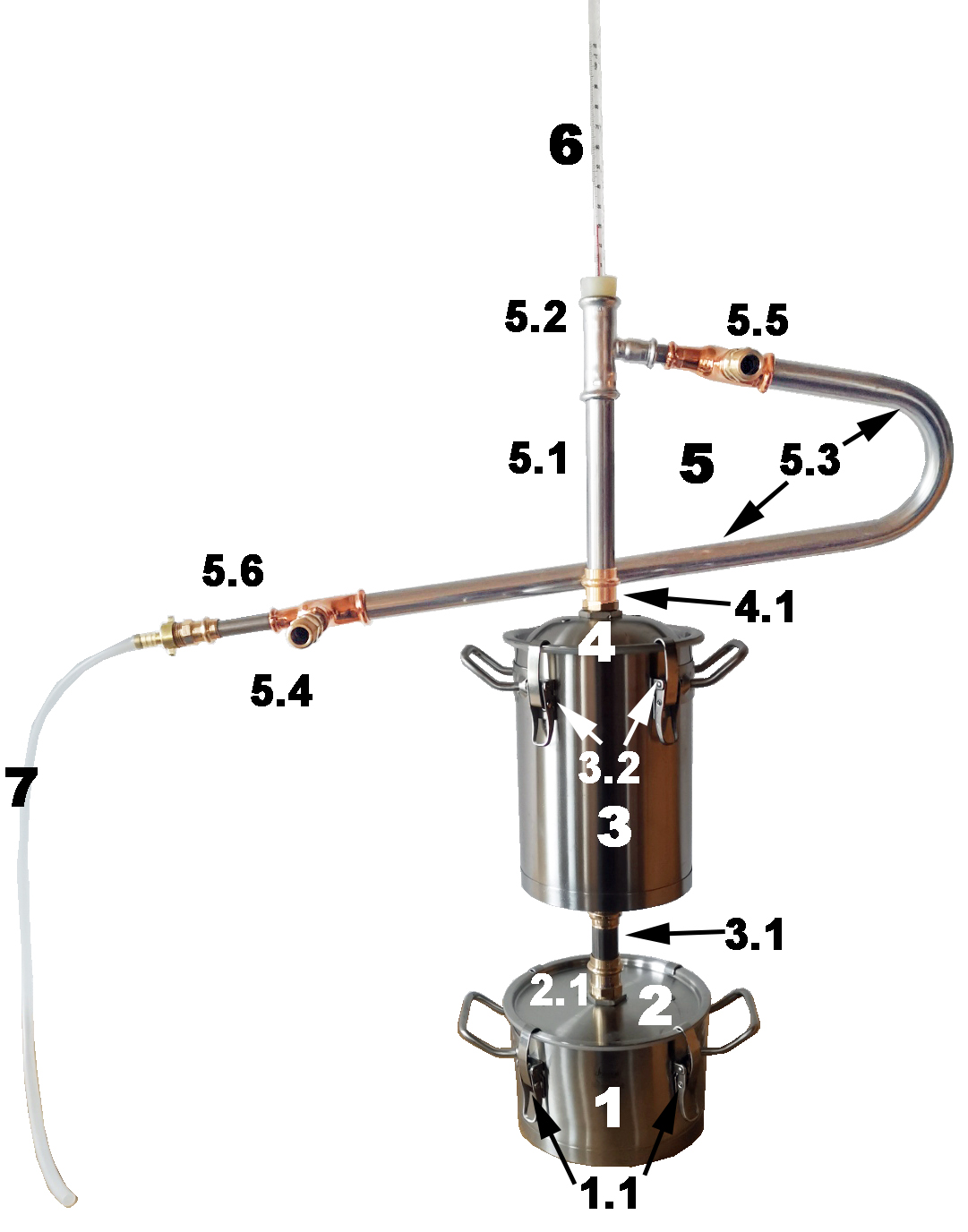
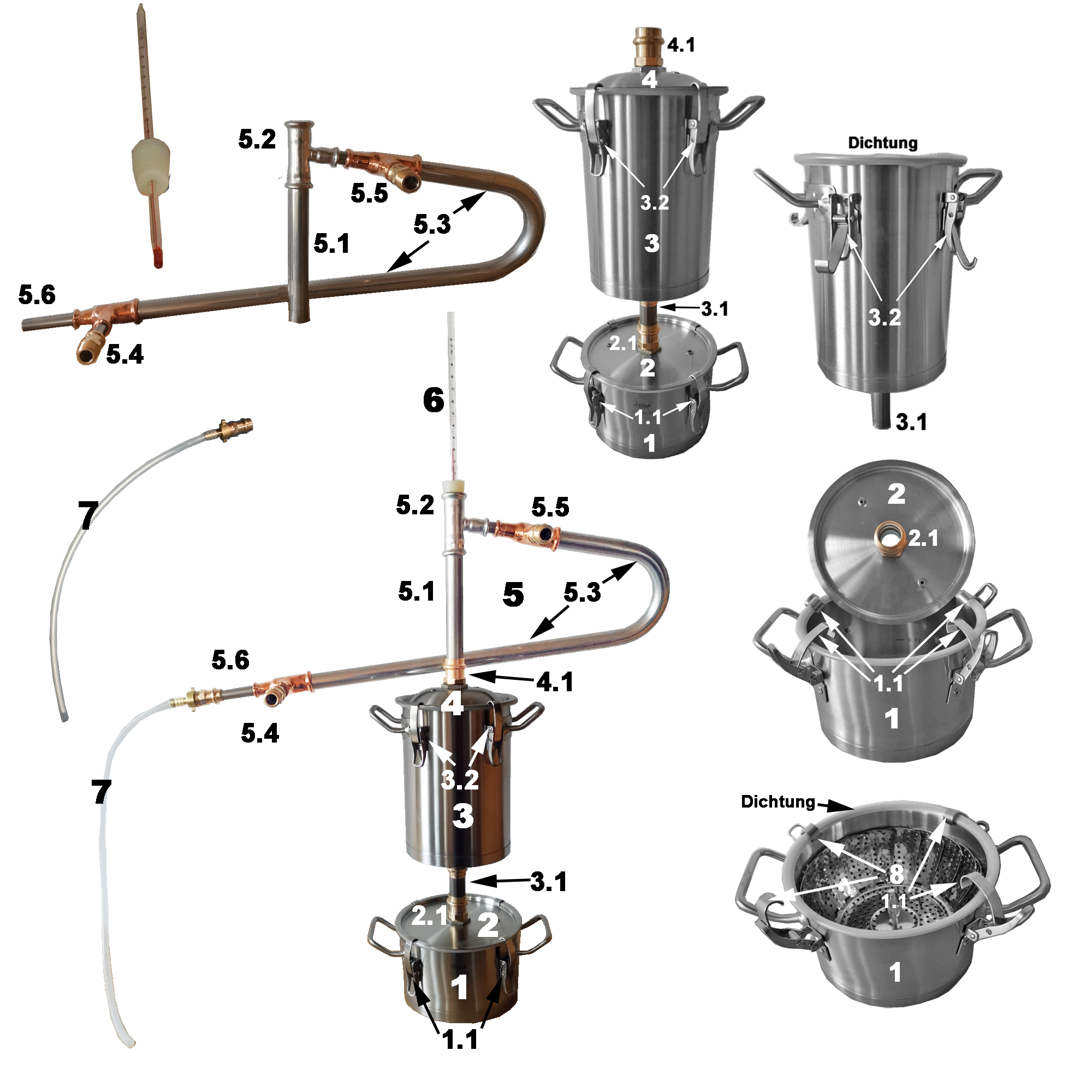
Construction
- Water/steam boiler, 2 litres. Approx. 1.5 litres of water are filled in.
- 4 clamping fasteners for securely closing the water/steam boiler using 1.1.
- Lid for closing the water boiler.
- Socket for the plant tube.
- Plant/drug tube, approx. 3 litres capacity.
- 4 spring locks for locking the plant tube.
- Lid for locking the plant tube.
- Socket for the distillation bridge 5.
- Distillation bridge with curved countercurrent condenser
- riser tube
- thermometer socket
- double-tube condenser in countercurrent (jacket on the outside, core on the inside)
- cooling water inlet
- Hot water outlet
- Hydrosol outlet
- Laboratory thermometer with silicone stopper, insert in 5.2.
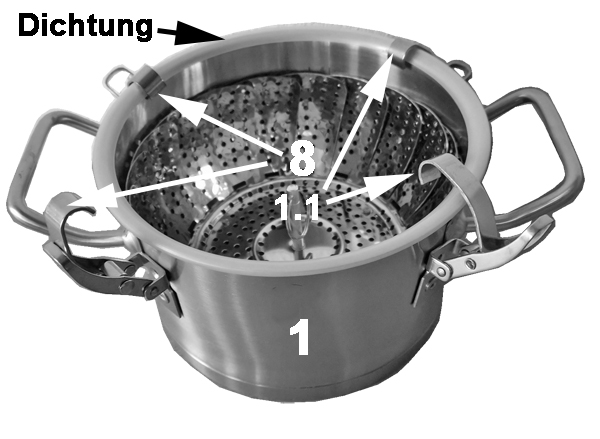
- Aroma basket for insertion into the vapour pipe. This is about 3 cm from the bottom and has a closed baffle in the middle so that the rising vapour jet does not flow directly through the plants and create a tunnel effect due to the jet stream, which would lead to significant losses. The vapour first flows radially due to the baffle and then rises by its own thermal. The plant tube has a height/diameter ratio greater than 1, so that an effective chimney effect promotes the drag effect.
- Insert the aroma sieve for small quantities of plants at the top.
- Perforated plates are not required for essential oils.
Alcohol distillation outside of Germany
As a hobby, aromatic fruit brandies - and spirits - are the most popular. In addition to its suitability for fruit distilling, the FLEXI2-3 Supreme is also particularly suitable for alcohol vapor flavoring. To do this, fresh fruits or herbs are placed on the inserted aroma basket (8) in the column. Dilute (approx. 15% by volume) neutral alcohol is poured into the lower pot. Then the water-alcohol vapor mixture is amplified and flavored in the column.
When distilling mashes, there are several distillery processes that we would just like to briefly outline here. Further instructions can be found on the portal https://cd.destillen.de. This is password protected. You will receive your username and password after purchasing a distillery. There you will also find the instructions for your respective still.
The combustion processes are:
- Potstill procedure. Here you work without a reflux amplifier and usually burn 3 times to crystallize out the middle course. This process requires a lot of experience in separating the pre-run and post-run and good sensor technology, which is only acquired over time. Beginners would be advised against it, because mistakes are very clear in terms of taste. Traditional whiskey e.g. B. is produced in 3 firing stages in the Pottstill process. Experienced potstill distillers do not have to explain anything here.
- Rectifying or reflux firing. Here, too, it is about the clean separation of the pre-carriage and on-carriage. This method can be split into 2 further parts:
- Single firing with at least 2 columns. Even that should not necessarily be used by beginners, because good sensors are also required here. You can of course try it out, but you shouldn't be disappointed if it doesn't quite work the first few times. You can work out flavors very well in this process, but this is often forfeited by the imprecise separation of components. Not that it is a bad thing, because pre-run or post-run errors can be corrected afterwards. A preprocessing error is the easiest to correct. Simply put the distillate back into the still and distill a few ml from the beginning. Then let the rest of the pot cool down in the still. When you have distilled enough, the run-up error is corrected. In the case of run-up errors, you have to burn the distillate all over again and leave a residue in the kettle. So the main difficulty is not correcting a bug, but realizing what the bug is. This again requires experience with sensors.
- Double combustion process. Here the distillation is divided into 2 parts:
- Distill the raw spirit. You can do that with the still and the distillation bridge alone. One does not care about the separation, but first burns the mash until the thermometer shows over 95 ° C. Then only a little alcohol comes out. Usually you have a larger amount of mash, from which you first produce raw brandy until the complete mash of a batch has burned down. When distilling the mash, it is important to ensure that the mash does not burn in the bladder. The mash sieve (8) in the still is used for this. If the mash contains residual starch, the mash sieve alone is not sufficient. You can minimize the risk by using an amylase that saccharifies the residual starch. It is best to do a distillation-test with a small amount of the mash liquid before distilling. If you notice a tendency to burn, you should cut a kitchen towel so that it is also placed on the mash sieve before filling the bladder, and some water is poured under the mash sieve so that the bottom of the pot is not dry at first.
-
-
- Create fine brandy. The collected raw fire has been intensified during the first firing to such an extent that one can largely rely on the thermometer. Don't forget to make a note of the initial alcohol content of your raw spirit. Of course, you cannot do without sensors here either. You will now have a larger amount of raw spirit available, so that you can feel your way the first time and record the temperature curve well: At what temperature did I start the middle course and at what temperature did the after-run start. This gives you a characteristic curve that is valid for your system, which you can use for the following fine fires and which you no longer rely so much on the sensors. However, the characteristic curve is also different for a different starting alcohol content. After a while, however, you will have a set of characteristics that will make your later work much easier. If you have done everything correctly, you will be rewarded with a fragrant and tasty fruit schnapps. Remember, the freshly distilled food is a little rough at the beginning. Whirling through the fresh distillate already provides some remedy. You only get a high quality after the distillate has matured through storage, with little exchange of the distillate with the environment; so do not close the storage container airtight. For more information, please refer to the above portal.
Now we come back to the still. You fill a maximum of 85% of the total volume of the pot still with raw spirit and then close the pot. You then insert the column 3 into the socket 2.1. The sieve 8 is now used here as a column tray. At the top of the column you place the sieve 9. You now have a 2-stage column: The whole thing looks like this:
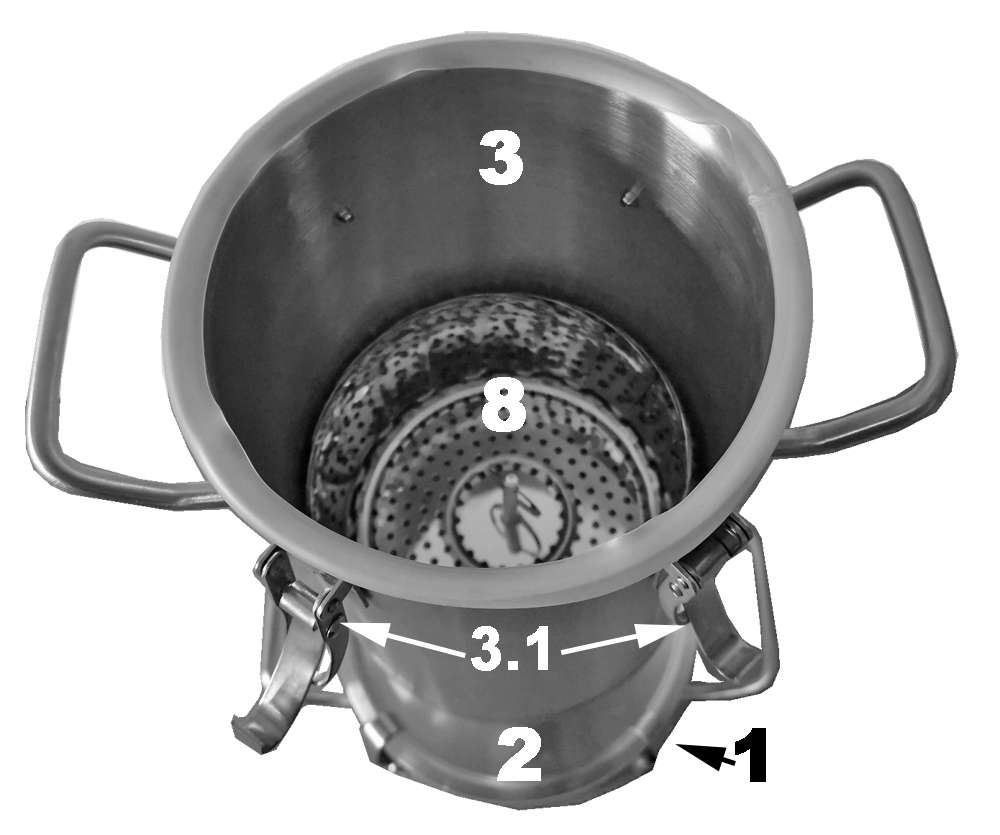
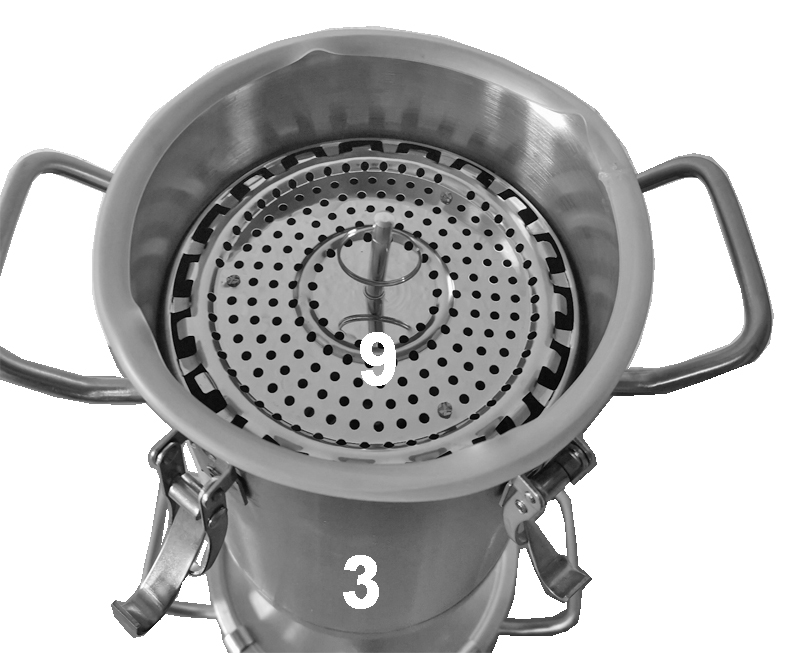
Otherwise the column tube remains empty. You can also try leaving out sieve 8 to reduce the gain and only work with 9. The pipe itself also produces rectification. You can also increase the gain by folding the sieve 8 together. Try for yourself and you will get the best results. Now put the cover 4 on and put the distillation bridge in 4.1 and the distillate line 7 in 5.6.
Alcohol cleaning (outside Germany)
An example of alcohol cleaning is when you collect all of the after-runs and then do cleaning fires. There is still a lot of alcohol in the wake, and it can be distilled out as neutral spirit. Now the reinforcement must be at its maximum, and you fold the sieve 8 at the bottom and now also use the perforated lamellas 10. It looks like this:
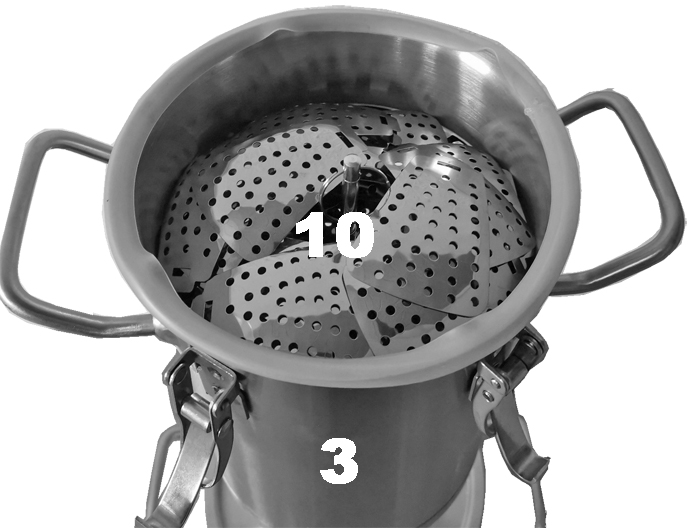
You are now distilling out the alcohol; Voirlauf doesn't exist anymore. In the case of cleaning fires, the overrun is now separated a little more generously. Either an alcohol refractometer is used for this, or a small measuring cylinder with a small alcoholometer is used. With the former, a drop is sufficient, with the latter, the withdrawal amount should be as small as possible. It is important to determine the current alcohol content. The cleaning firing can be ended at 70% by volume. You can really use the caster from the caster now.
Important NOTE:
With the new German alcohol tax law, this still can also be sold legally in Germany since January 1st, 2018 and without registering with the authorities. Please note that we as retailers have to point out that this still may only be used for the distillation of distilled water, hydrosols, essential oils, aromas, fragrances, perfumes, foods, for alchemical experiments, etc. or as a collector's item. If you distill alcohol and get caught doing it, expect a fine and the confiscation of the still.