


.png "Kessel und Pflanzenrohr")
.png "Aromakorb")


.png "Preview: Kessel und Pflanzenrohr")
.png "Preview: Aromakorb")


.png "Kessel und Pflanzenrohr")
.png "Aromakorb")

Manufacture of optimised stills since 2006
No more silicone seals required
You’ll save around €60 compared to buying them separately
DESTILLIERMEISTER E2-4 Supreme-Plus horizontal - with all the necessary accessories for professional use
A legal, licence-free stainless steel still for essential oils, featuring a generous 4-litre plant chamber.
This unit itself differs from the standard E2-4 Supreme-Plus variant in that the thermometer is positioned horizontally
- The unit is only 60 cm high in total and therefore fits under most extractor hoods.
- The modified vapour path reduces the pressure within the unit (by diverting the vapour through a larger cross-section) and minimises the backflow of essential oil.
- The reduction in pressure also lowers the temperature within the system, as pressure and temperature are directly proportional to one another.
25 ml of essential oil in 8 minutes – that’s what we achieved using 400 g of lavender flowers.
With 4 litres of plant chamber capacity, you have plenty of space to process even larger quantities of plants or herbs. Steam is generated in a separate boiler beneath the plant chamber, ensuring that contact with boiling water is impossible.
Best of all: as the water boiler has a capacity of just 2 litres despite the large plant container, the DESTILLIERMEISTER E2-4 Supreme-Plus horizontal model may be legally sold and operated in Germany and Austria without the need to notify customs.
Easy to use:
- In this model, optimised clamping fasteners mean that no seals are required between the 1st and 2nd or the 3rd and 4th sections. The sealing is achieved by metal-to-metal contact. Consequently, there are no further running costs associated with this model.
- Fill the water/steam boiler with at least 1.3 litres and no more than 1.7 litres of water – ideally demineralised or distilled water.
- Fit the 4-litre plant tube and seal the boiler using clamping fasteners 1.1.
- Place the aroma basket inside the plant tube and open it up.
- Fill to the brim with herbs or medicinal plants – do not pack them down. This amounts to approximately 4.2 litres.
- Fit lid 3 and tighten the clamps 2.4,
- insert the distillation bridge 5 into the socket 4.1,
- screw the cooling water hoses onto the cooler.
- Switch on the heat source and collect the hydrolate with oil at 5.6.
- Distil for approximately 8 minutes at high power (induction hob 3000 watts). This should yield 500 ml of distillate.
The water/steam vessel and the plant/herb tube, as well as all distillate-carrying pipes and connections, are made of stainless steel.
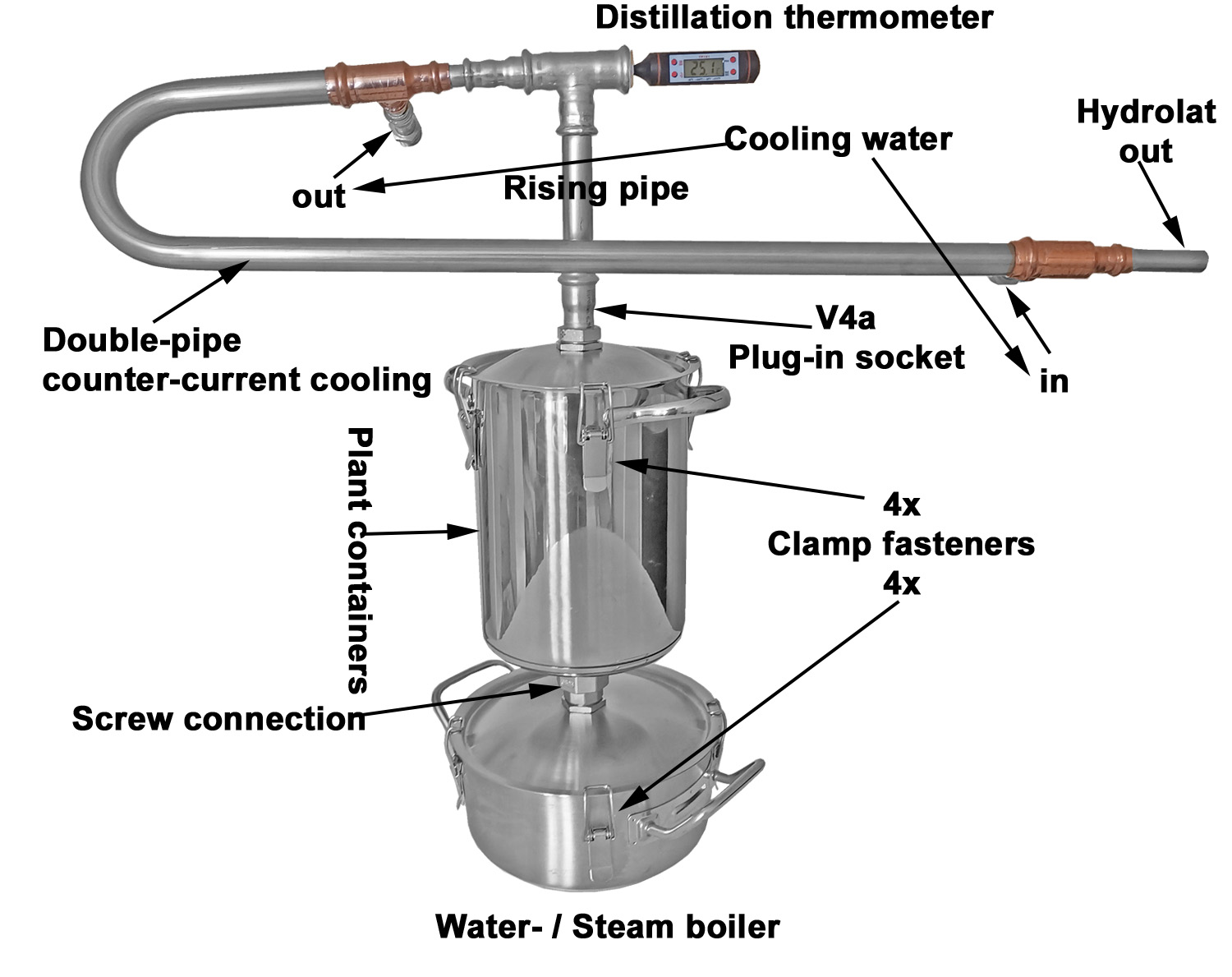
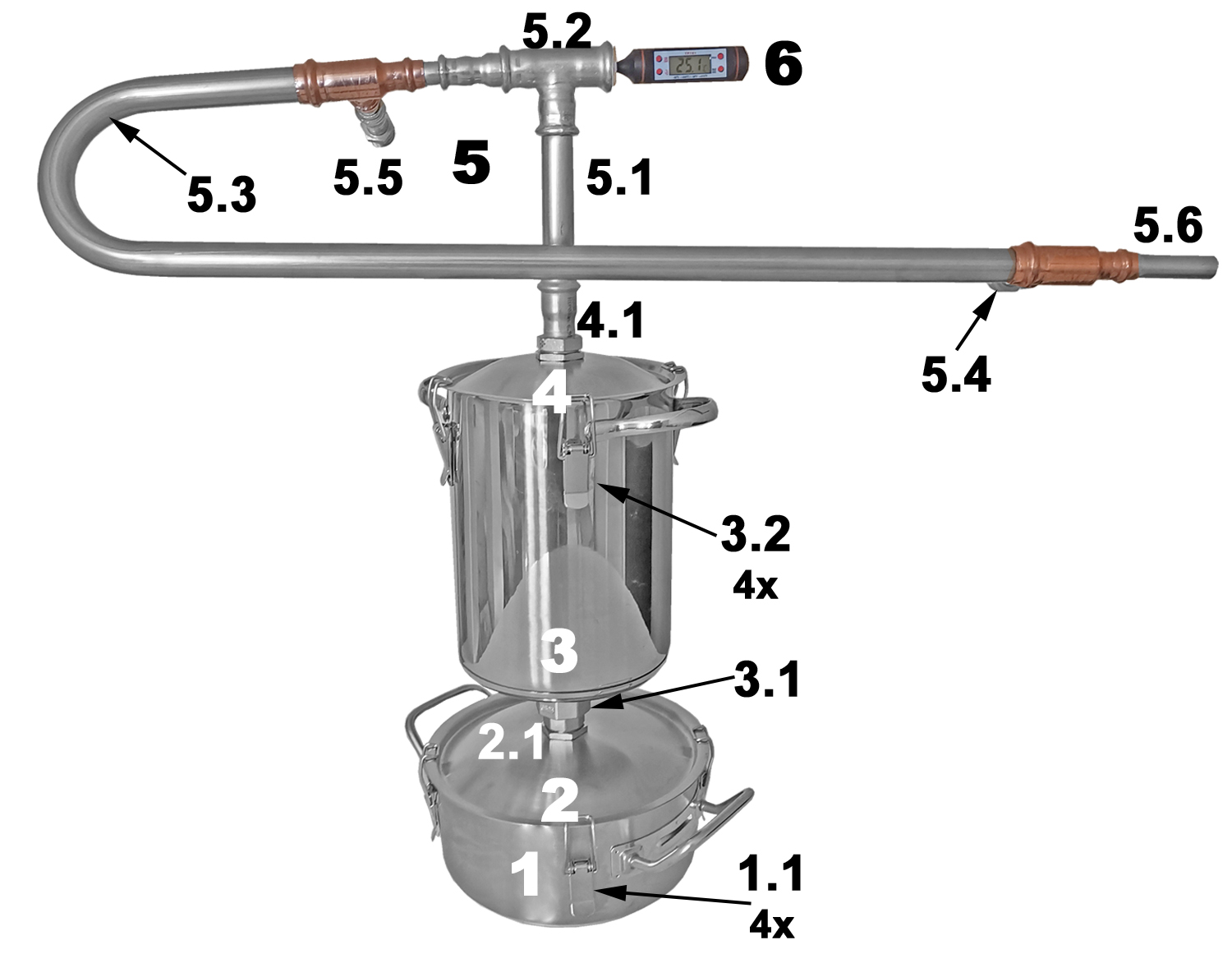
Construction
Sammeln, trennen und analysieren
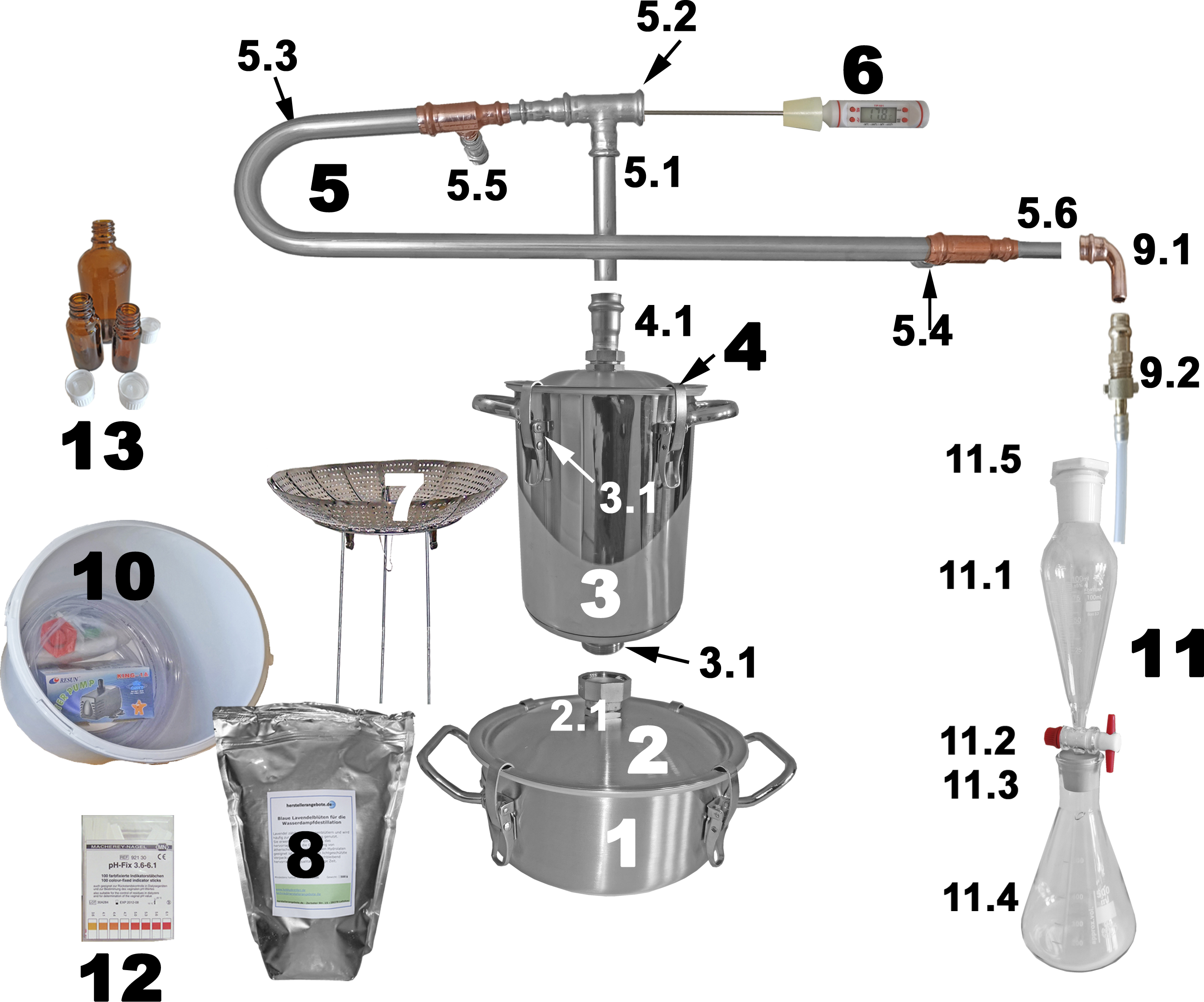
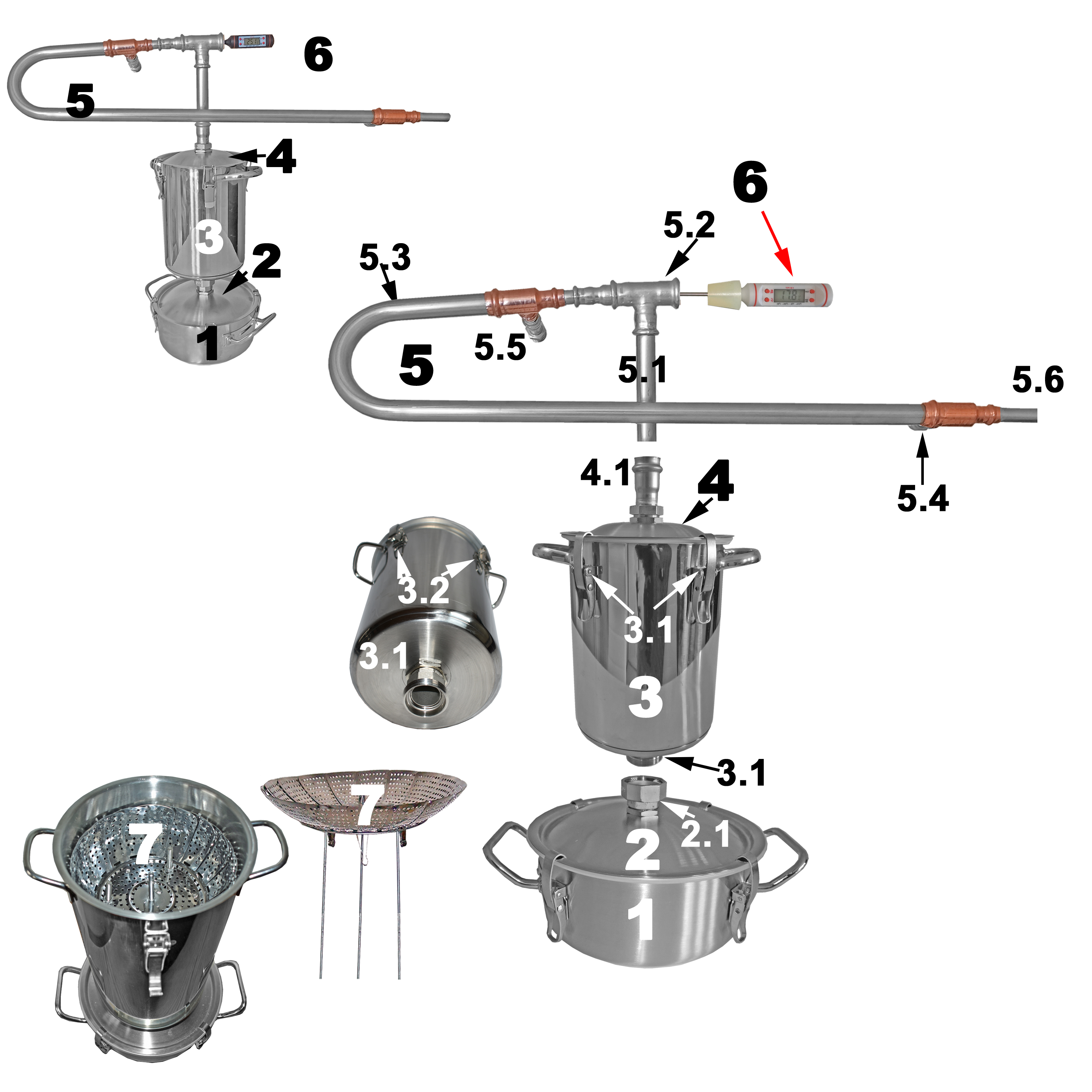
Details
- Water / steam boiler with lid, 2 litres. Approx. 1.7 litres of water are filled.
- 4 clamp fasteners to securely close the water/steam boiler.
- Lid
- 3/4" screw connection for connection to the plant pipe.

- Plant/drug pipe, approx. 4.2 litre capacity.
- Screw nipple for connection to the water boiler,
- 4 clamps for closing the plant tube with the lid 3.

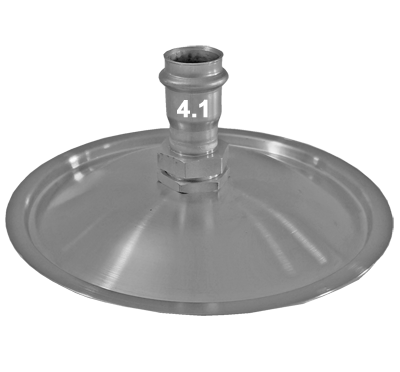
- Lid with socket for the distilling bridge 4.
- Socket made of V4A stainless steel.

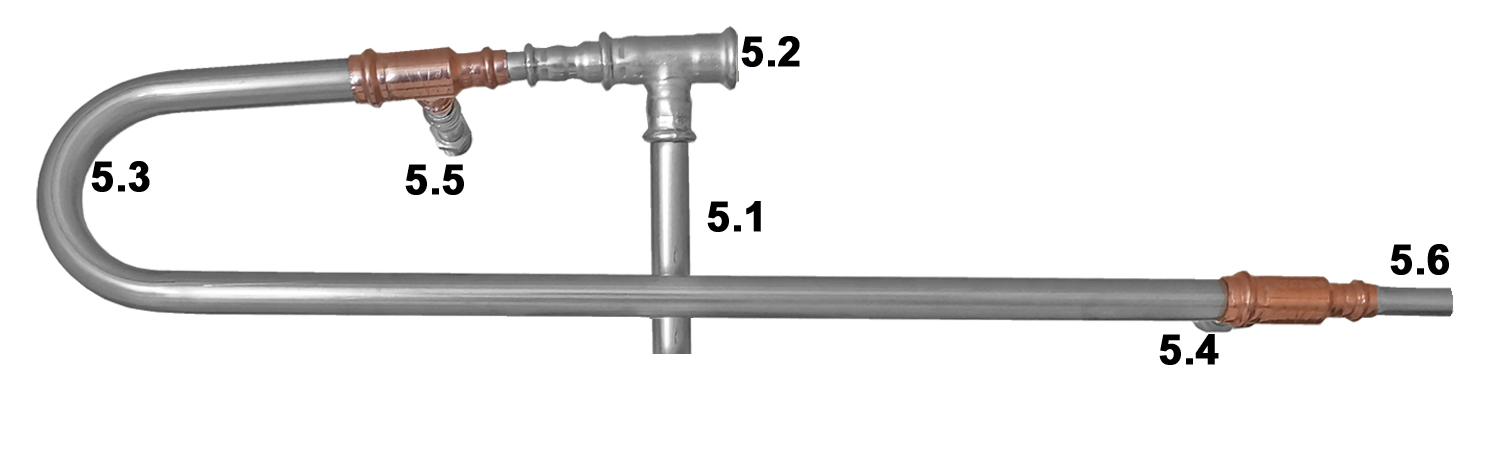
- Distilling bridge with curved counterflow capacity cooler with a cooling length of at least 85 cm.
- Riser pipe
- Thermometer socket
- Double-tube cooler in counterflow (outer jacket, inner core. The cooling water flows between the core and shell and the vapour or liquefied distillate flows in the core. Cooling water and distillate flow in opposite directions).
- Cooling water inlet
- Hot water outlet
- Hydrolat outlet
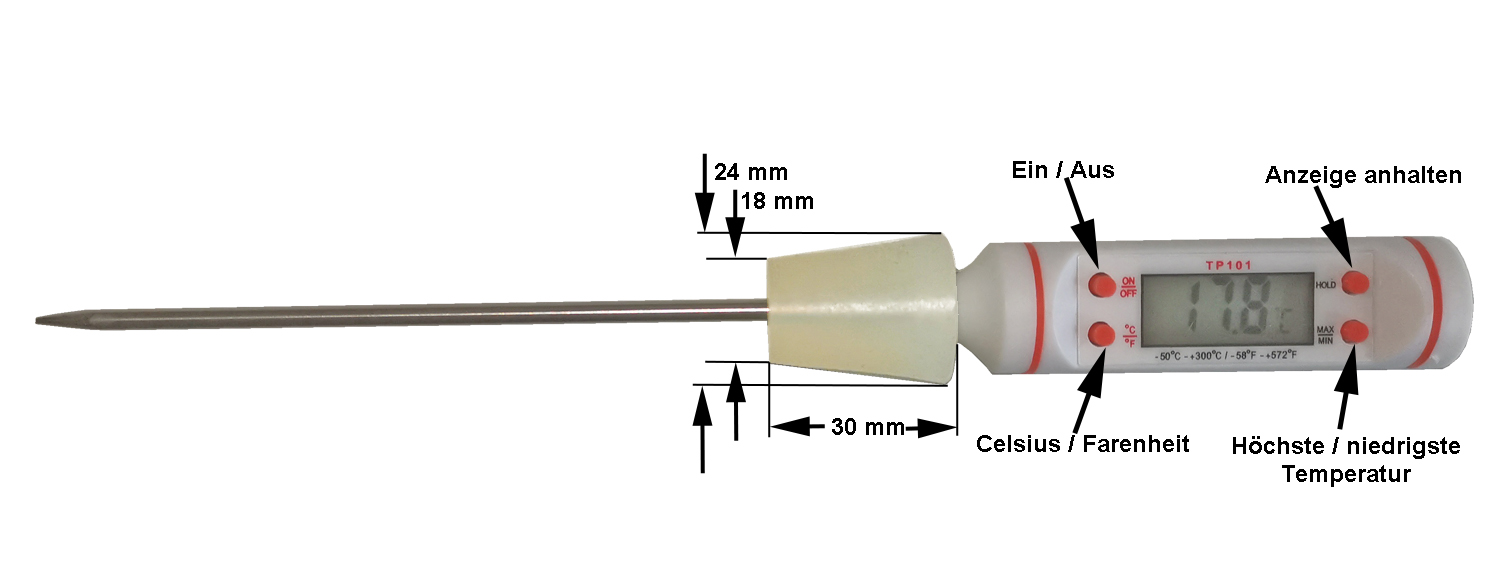
- Digital thermometer with silicone stopper, insert into 5.2.
- Flavour basket with adjustable legs. When the pipe is completely full, insert into the steam pipe - without screwing in the adjustable legs. The aroma basket is then about 3 cm away from the base and has a closed storage area in the centre, so that the rising steam jet does not flow directly through the plant material and blow a tunnel due to the jet effect, which would lead to heavy losses. The vapour initially flows radially due to the accumulation surface and then rises due to its own thermal effect. The plant tube has a height/diameter ratio greater than 1, so that an effective chimney effect favours the drag effect If you also want to work with smaller quantities of plant material, you can screw in the legs and adjust the height of the basket variably. Caution: Do not heat with more than 1500 watts when only half full.


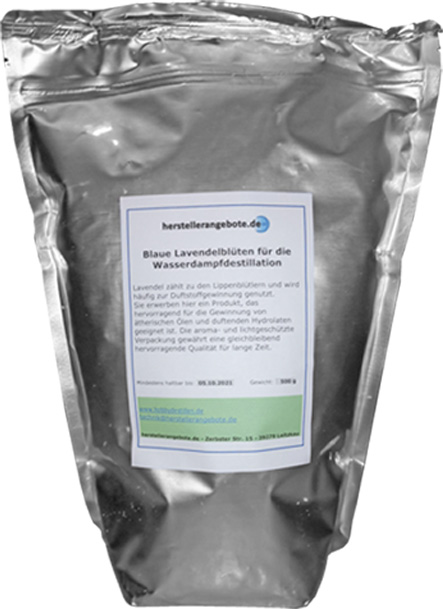
- 500 g blue lavender flowers in distillation quality in a flavour and light protection bag.
- Tools to direct the hydrolat into the separating funnel.
- Bow for attaching to the distillate outlet 4.6. This is used when everything is on the same level, e.g. when using an electric cooker.
- Push-on sleeve with hose. The sleeve is either pushed directly onto the distillate outlet 4.6 or onto the elbow 8.1 if the still is placed on a raised heating plate (example in the picture below). You may have to shorten the hose, this depends on the heating plate, under no circumstances should the hose be immersed in the hydrolat.
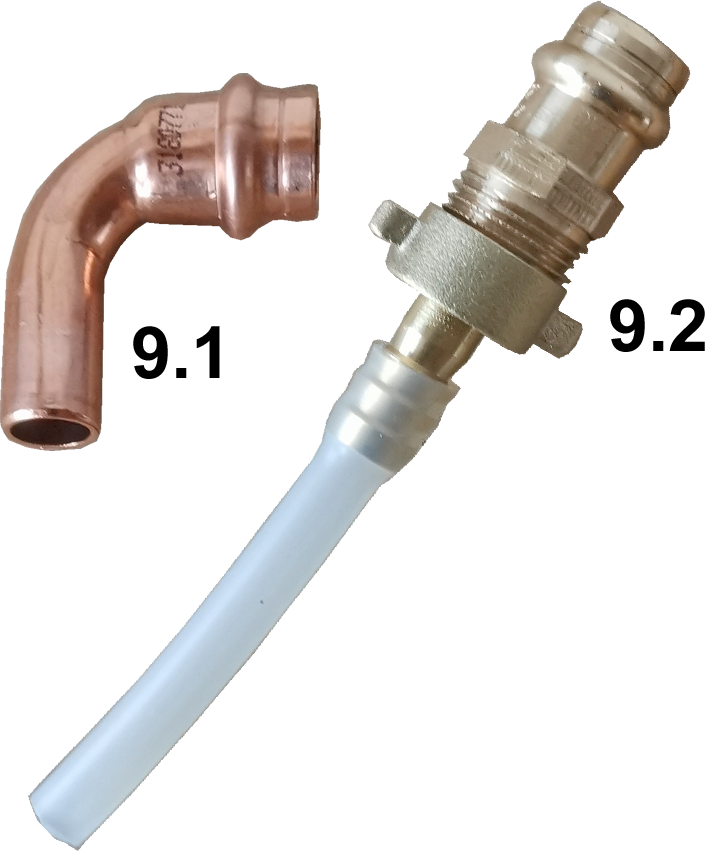
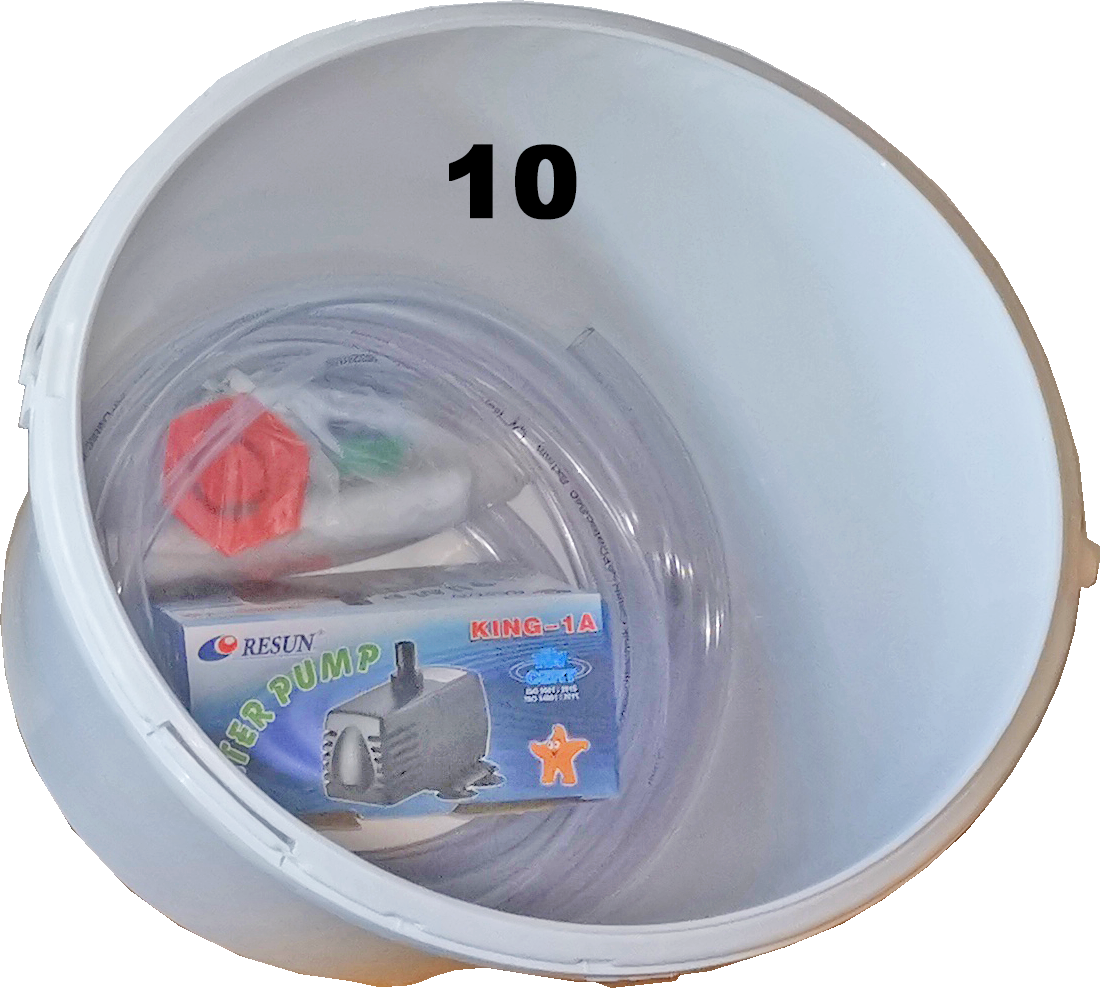
- Set for the cooling water supply with the following accessories
- 20 litre plastic bucket as cooling water reservoir.
- Powerful 230 volt cooling water pump with accessories for different hose diameters, sufficient for all our stainless steel stills up to approx. 20 litres.
- Various PVC hoses of 2 metres each, including 2 hoses with hose fittings for the distillation cooler, one of which is prepared for connection to the pump. In addition, 3 hoses of different thicknesses for various applications, e.g. hose extension or decanting of hydrolates, etc.
- Plastic tap for cooling water regulation, suitable for the counterflow cooler.
- Scaled 100 ml measuring cylinder with base for taking distillate samples, e.g. to measure the pH value.
- Cleaning brush.
- Floating thermometer to check the cooling water if the hot waste water is allowed to run back into the bucket. Above 40° C, the water should either be cooled with ice or replaced.
- A roll of Teflon tape for sealing, e.g. if a seal becomes defective during distillation.
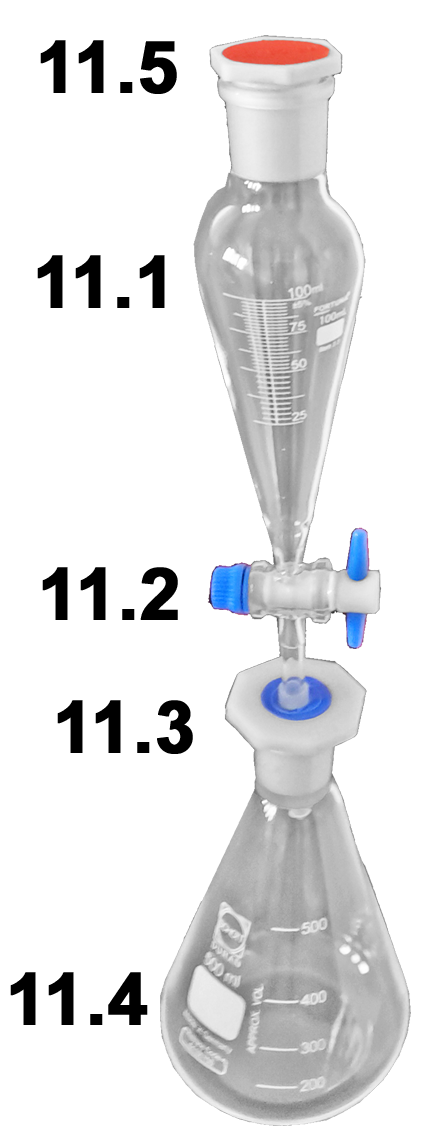
- Oil separator device, consisting of the following parts
- The separating funnel. This collects the hydrolate first.
- PTFE plug. In the picture, this is set to maximum flow. Turned through 90°, it closes completely. It is closed at the start of distillation. Once you have collected around 60 to 70 ml, open it slowly and allow the hydrolat to flow out. Ideally, the hydrolat should flow into the collecting flask as quickly as it flows into the separating funnel. The oil collects on the surface of the hydrolat in the separating funnel.
- Plug for the collecting flask with feed-through. This can also be designed as a silicone stopper.
- Collecting flask (Erlenmeyer flask - it can vary in appearance depending on the supplier). You should definitely distil 500 ml; the non-water-soluble essential oil is now almost completely distilled off. If you want to continue collecting hydrolat, you should switch off the heat source briefly, decant the hydrolat or place a new flask underneath. Do not forget to close the plug 9.2 during this operation.
- Stopper, suitable for separating funnel and Erlenmeyer flask. This is not required for distilling.
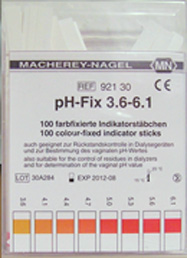
- pH measuring sticks, pH value between 3.6 and 6.1, 100 pieces. A hydrolate below pH 4 is of very high quality. From pH 6 or above, you should decide whether you want to stop the distillation. The hydrolat still smells good now, but can no longer be stored so well.
- Amber glass set, sealable with original caps including droppers for storing the extracted essential oil.
- 10 ml bottles,
- 20 ml bottles,
- 50 ml bottles.
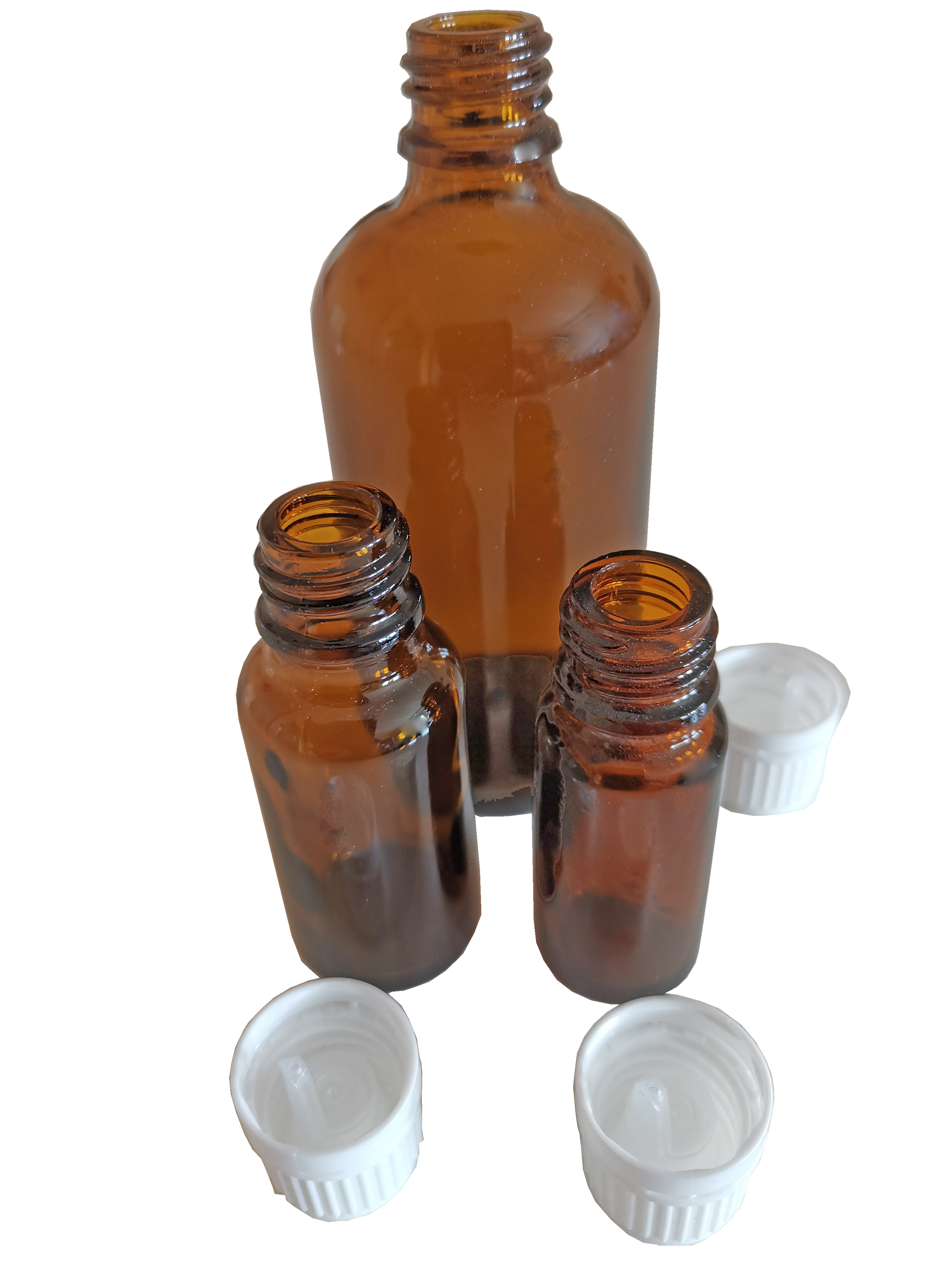
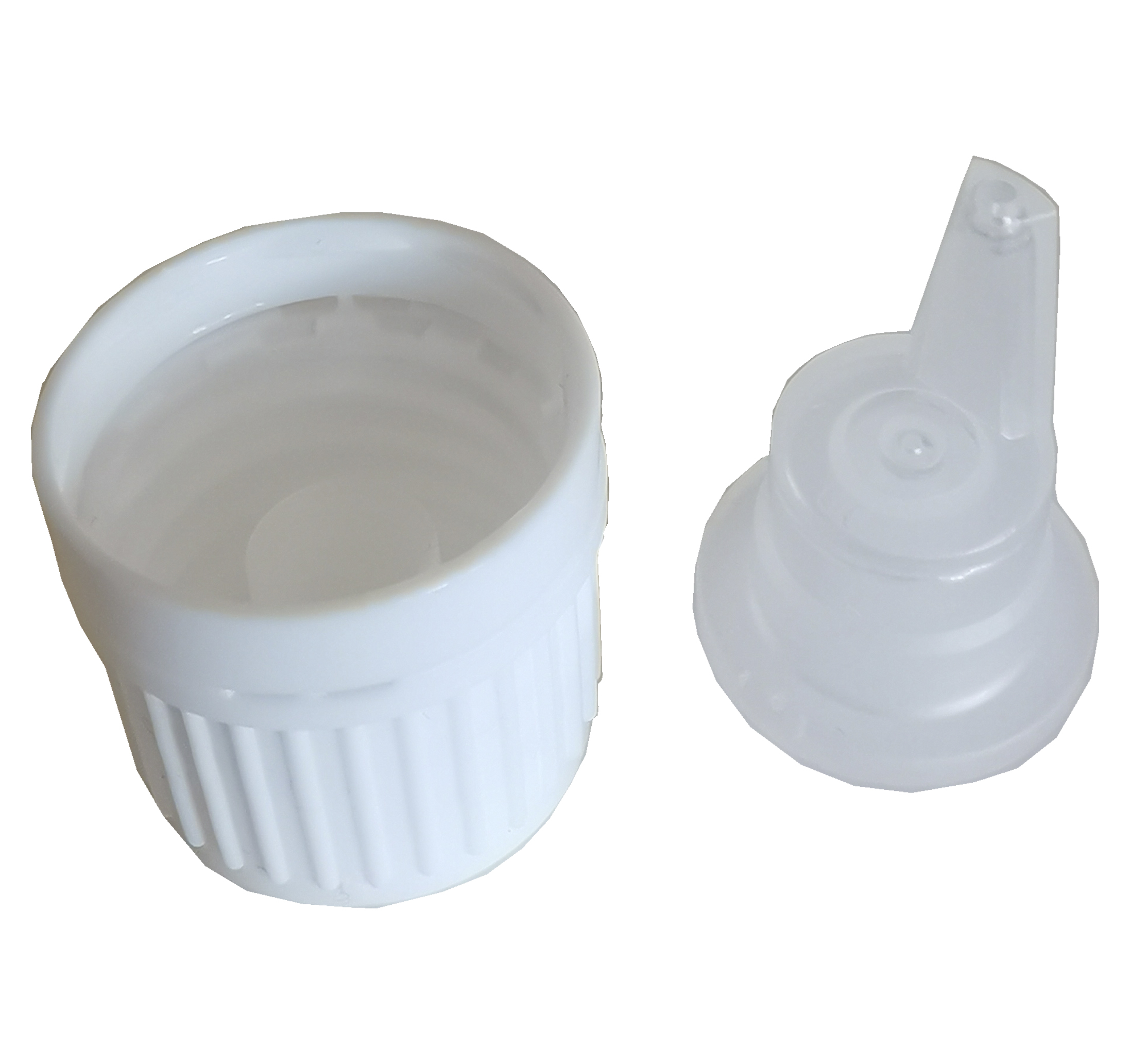
- Original caps with removable dropper inserts. The original caps are ideal for closing and sealing gift or retail bottles.
Test run with an identical system
Heating source: Induction, output after heating time (approx. 3 min) 3000 watts. This output should be lower if not completely filled.
Drug: Dried lavender flowers
Quantity: 400 g
Total distillation time: 20 min
Hydrolate extraction: 2 batches, one per 10 min
- Batch: 500 ml after 15 min, oil yield 25 ml, hydrolate pH value: 3.2
- Batch : 500 ml after a further 15 min, no oil, hydrolate pH value: 3.6
The yields may vary depending on the harvest or harvest time. Rain shortly before harvest can significantly reduce the yield. Harvest after at least 2 days of sunshine.
Important note:
With the new German Alcohol Tax Act, this distillate may also be sold legally in Germany since 1 January 2018 and without registration with the authorities. Please note that as a retailer, we must point out that this still may only be used for the distillation of distilled water, hydrolates, essential oils, flavours, fragrances, perfumes, food, alchemical experiments, etc. or as a collector's item. If you distil alcohol and are caught doing so, you will be fined and the distillation equipment will be confiscated. However, I can give you one legal tip. You can make delicious spirits from hydrolates by mixing them with taxed alcohol and water to drinking strength. Try a spirit made from a fennel seed hydrolate.